What Is a BFR in Aviation? Your 2026 FAA Flight Review Guide

Published by:
Georgette P.
Published on:
Updated on:
Read time:
8 min read
Your BFR is coming due, and the question in your head is simple: “Am I about to be tested?”
The short answer is no. A BFR in aviation means a flight review, often still called a biennial flight review because most pilots need one within the preceding 24 calendar months to act as pilot in command. But the FAA does not treat it like a new checkride. The goal is not to trap you. The goal is to help you prove you are current, sharpen the skills you actually use, and leave with a safer plan for the next two years of flying.
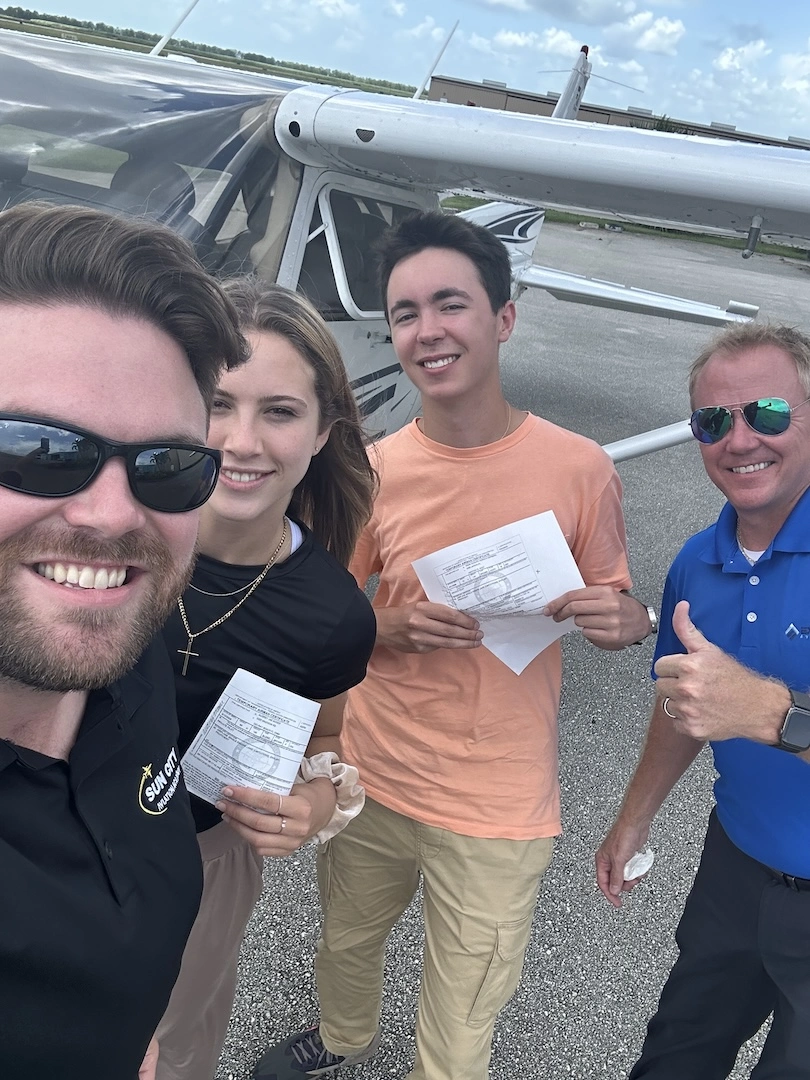
At Sun City Aviation Academy, we conduct flight reviews from our North Perry Airport (KHWO) location in South Florida. If you fly for fun, travel, business, training, or career building, your review should match the way you fly. A pilot who mostly makes local VFR flights does not need the same review profile as a pilot who flies cross-country trips through busy South Florida airspace.

What a BFR Means for Your Next Flight
The FAA term is flight review. Many pilots still say BFR, but the word “biennial” can make the review sound more rigid than it really is. Under 14 CFR 61.56, most pilots may not act as pilot in command unless they have completed a satisfactory flight review within the required 24-calendar-month period, unless one of the rule’s exceptions applies.
That matters because your review is not just paperwork. It is the legal reset that keeps you eligible to act as PIC, and it is also a chance to have an instructor look at your flying with fresh eyes.
The FAA minimum includes:
- At least 1 hour of ground instruction
- At least 1 hour of flight instruction
- A review of current Part 91 operating and flight rules
- A review of maneuvers and procedures your instructor selects
- A logbook endorsement when satisfactory completion is achieved
The word minimum matters. If you are current, sharp, and prepared, the review may be straightforward. If you have not flown much lately, your instructor may need more time with you before signing the endorsement. That is not a failure. That is instruction doing its job.
If you already know you need the review soon, start with our Flight Review (BFR) program and schedule enough time to make the session useful, not rushed.
Why the Flight Review Is Not a Checkride
This is the part that removes the most stress.
A flight review is not a private pilot checkride, instrument checkride, or commercial checkride. There is no examiner sitting across from you with a new certificate on the line. You work with an authorized instructor, and the instructor signs your logbook when the review has been completed satisfactorily.
If your flying is rusty, the answer is not a checkride-style failure. The answer is more dual instruction.
That distinction changes the whole tone of the day. You are allowed to ask questions. You are allowed to say, “I have not practiced stalls in a while,” or “I want extra work on landings,” or “I am not fully comfortable with the airspace around KHWO.” Those are useful starting points, not admissions of weakness.
The best flight reviews are honest. The instructor needs to know how you actually fly, where you feel confident, and where you feel exposed. From there, the review can become a clean tune-up instead of a stressful guessing game.
What Happens During the Ground Portion
The ground portion is where you clean up the rules, planning habits, and decision points that affect every flight before the engine starts.
At a minimum, your instructor must review the current general operating and flight rules of Part 91. In normal language, that means the rules that shape day-to-day general aviation flying: airspace, weather minimums, right-of-way rules, required documents, currency, aircraft airworthiness, and PIC responsibilities.
For a South Florida pilot, this can become very practical. You may review:
- KHWO airspace and local procedures so you know what to expect before taxi
- Weather decision-making because fast-changing Florida weather can turn a simple flight into a real judgment call
- Personal minimums so you are not making your first hard decision in the airplane
- Aircraft documents and inspections so you know whether the aircraft is legal and ready
- Recent rule or procedure gaps that may have changed since your last deep review
This is also the right time to talk about your next goal. If your next step is an Instrument Proficiency Check, an Instrument Rating, or more regular cross-country flying, your instructor can shape the review around that path.

What Happens During the Flight Portion
The flight portion should prove that you can safely control the aircraft, manage normal and abnormal situations, and make sound decisions as PIC.
Your instructor chooses the maneuvers and procedures based on your certificate, aircraft, experience, and flying profile. For many airplane pilots, the review may include:
- Takeoffs and landings with attention to stable approaches, runway alignment, and go-around judgment
- Slow flight and stalls so you stay comfortable near the edges of the envelope
- Steep turns or other control exercises to confirm smooth aircraft handling
- Emergency procedures so your response is organized instead of rushed
- Navigation and diversion decisions to test real-world planning habits
- Radio and traffic awareness in the airport environment you actually use
The point is not to perform a memorized routine. The point is to show that you can fly safely today.
If something needs work, the review simply becomes targeted instruction. Maybe you need a few extra patterns to clean up landings. Maybe you need more emergency practice. Maybe you need help rebuilding confidence after time away from the cockpit. That extra time is not a setback. It is the value of having an instructor beside you before you fly passengers or act as PIC again.
How the ACS Affects the Conduct of Flight Reviews
Pilots often ask, “How does the ACS affect the conduct of flight reviews?”
The Airman Certification Standards, or ACS, gives instructors a current FAA benchmark for knowledge, risk management, and skill. It helps your instructor decide what “proficient” should look like for the kind of flying you do.
But the ACS does not turn your flight review into a checkride.
Think of it as a measuring tool. If you are a private pilot flying a Cessna for local and cross-country trips, the private pilot ACS helps frame safe performance. Your instructor can use that standard to decide whether your steep turns, stalls, emergency procedures, planning, and judgment are where they need to be.
That is good for you because it removes guesswork. Instead of wondering whether the review is based on one instructor’s personal preference, you get a review shaped by current FAA standards and your real flying needs.
For pilots who want to keep building skill after the review, the same ACS mindset can support a next step like Commercial Pilot Training or more focused recurrent work.
How to Prepare Without Overstudying
You do not need to bury yourself in books for weeks. You do need to arrive ready enough that the review can focus on useful flying instead of basic cleanup.
Start with these steps:
- Check your logbook date. Look at the month of your last flight review, practical test, or qualifying event. The 24-calendar-month rule is based on calendar months, not a simple day count.
- Review Part 91 basics. Focus on the rules that affect your real flying: weather minimums, airspace, currency, fuel planning, right-of-way, and aircraft documents.
- Bring honest notes. Write down what feels rusty. Landings, radio calls, stalls, crosswind work, weather planning, and emergency procedures are all fair topics.
- Know your usual mission. Tell your instructor whether you fly locally, take family trips, build time, rent aircraft, or plan to begin instrument work.
- Bring your documents. Have your pilot certificate, medical if required for your operation, photo ID, and logbook ready.
Preparation should lower pressure, not add to it. A good review starts with a clear picture of your flying life.
When Your Review May Take More Than Two Hours
The FAA minimum is 1 hour of ground and 1 hour of flight. That does not mean every review should be forced into a two-hour box.
You may need more time if you:
- Have not flown in several months or years
- Are transitioning into an aircraft you do not fly often
- Want to rebuild confidence before carrying passengers
- Need extra landing, stall, emergency, or radio work
- Fly in complex airspace and want more local practice
- Want to combine the review with broader recurrent training
This is where the review becomes valuable. If you discover a weak spot with an instructor, you can fix it before it becomes a problem alone. That is a much better outcome than chasing the shortest possible session.
If cost is part of your planning, Sun City Aviation Academy partners with Stratus Finance for flight training financing options. We do not want money questions to stay vague, so bring them up early when you schedule.
Can Another Event Count Instead of a Flight Review?
Sometimes, yes.
Under 14 CFR 61.56, certain practical tests, proficiency checks, and FAA WINGS activity can satisfy the flight review requirement. For example, passing a qualifying practical test for a certificate or rating can reset the review requirement. Completing one or more phases of the FAA WINGS program within the required period can also satisfy the rule.
Not every training event counts, and a rule exception should not be treated as a reason to skip useful recurrent training.
If your review date is close, talk with an instructor before assuming you are covered. The safest question is not only, “Am I legal?” It is also, “Am I sharp enough for the flying I plan to do next?”
A Simple Flight Review Plan at KHWO
At Sun City Aviation Academy, we like the review to begin with your actual flying profile.
A useful review plan may look like this:
- First, we talk through your flying. What aircraft do you fly? How often? Where do you go? What feels rusty?
- Then we review the ground items that matter most. Part 91 rules, KHWO procedures, weather, airspace, aircraft readiness, and personal minimums.
- Next, we fly a profile that matches your needs. Local maneuvers, traffic pattern work, emergencies, navigation, radio work, or cross-country decision-making.
- Finally, we debrief clearly. If you meet the standard, your instructor endorses the review. If you need more time, you leave with a training plan instead of confusion.
That is what removes the stress. You know what the review is for, what standard you are working toward, and what happens next.
Flight Review FAQ
What is a BFR in aviation?
A BFR is the common nickname for a flight review. It is the recurrent review most pilots need within the preceding 24 calendar months to act as pilot in command, unless an exception in 14 CFR 61.56 applies.
Is a BFR still called a biennial flight review?
Many pilots still say biennial flight review, but the FAA term is flight review. The old nickname remains common because the review is tied to a 24-calendar-month requirement for most pilots.
Can you fail a flight review?
There is no checkride-style failure. If your instructor cannot endorse satisfactory completion yet, the time continues as dual instruction until you reach the needed proficiency.
How long does a flight review take?
The FAA minimum is 1 hour of ground instruction and 1 hour of flight instruction. Your review may take longer depending on your proficiency, preparation, aircraft, and goals.
Does the ACS make the flight review a checkride?
No. The ACS gives your instructor a current benchmark for knowledge, risk management, and skill. It guides the review, but it does not turn the session into a practical test.
Where can I schedule a flight review in South Florida?
You can schedule a customized Flight Review (BFR) with Sun City Aviation Academy at North Perry Airport (KHWO). We will help you build the review around your flying profile and current goals.
Schedule Your Flight Review with a Clear Plan
Your flight review is not something to dread. It is a chance to reset your currency, clean up rusty areas, and walk back to the airplane with more confidence than you had when you arrived.
If your BFR is coming due, schedule it before the calendar forces your hand. Bring your questions, your logbook, and an honest picture of the flying you want to do next.
Enroll now to schedule your customized flight review with Sun City Aviation Academy at KHWO.




 More Right Rudder