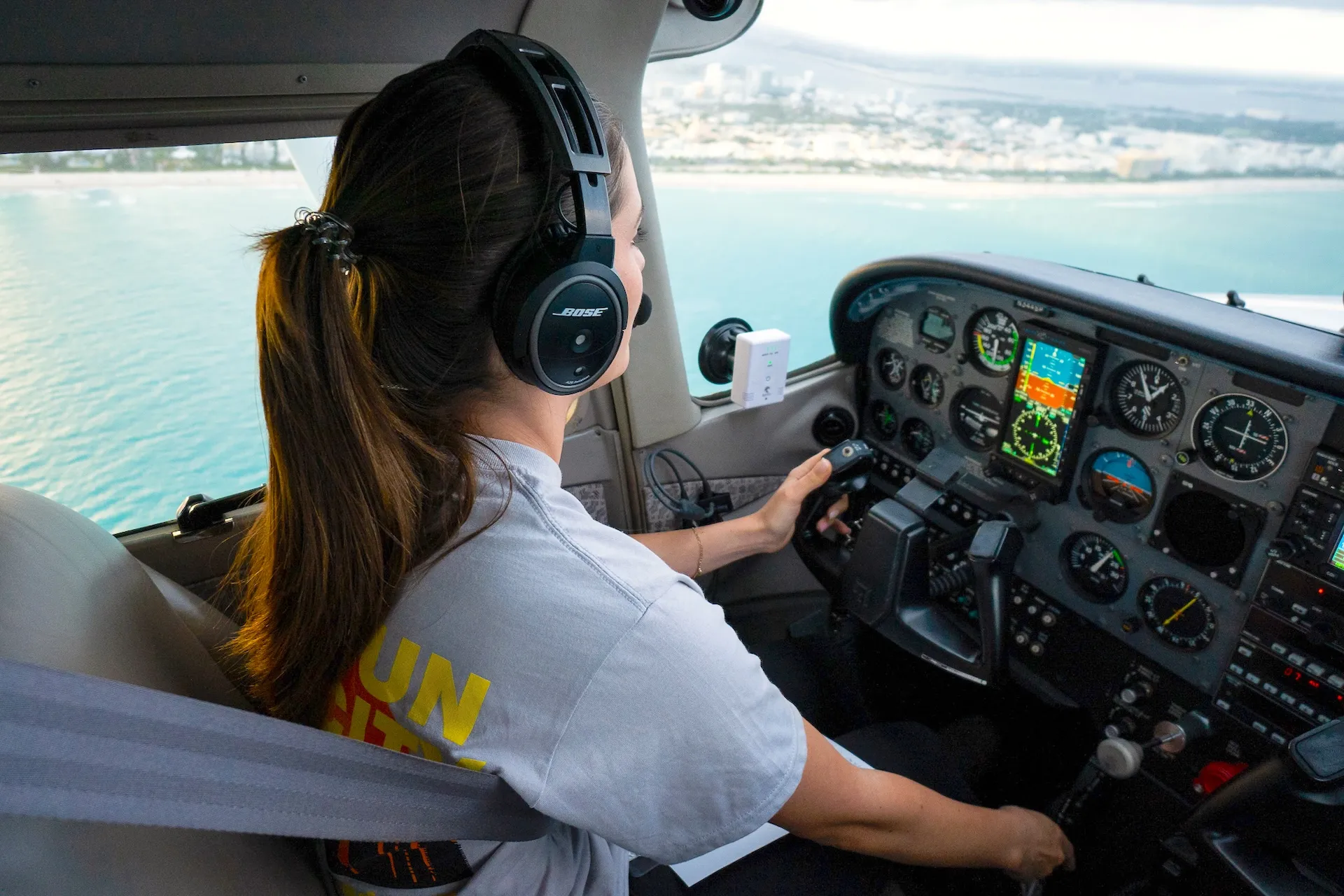
Commercial Pilot Course
Frequently Asked Questions
Get clear answers on flight hours, FAA regulations, checkride preparation, and career pathways for commercial pilot training at Sun City Aviation Academy.
FAQ
Commercial Pilot Certification Answers
Everything you need to know about training to fly for compensation or hire with Sun City Aviation Academy.
A Commercial Pilot Certificate is an FAA certification that legally authorizes you to act as pilot in command (PIC) of an aircraft for compensation or hire under 14 CFR Part 61 or Part 141. It is the mandatory credential required before flying commercially for charter companies, aerial survey operators, corporate flight departments, or advancing to an airline career. Explore our commercial pilot course for curriculum details.
Under FAA Part 61 regulations (14 CFR 61.129), you must accumulate at least 250 total flight hours, including 100 hours of PIC time and 50 hours of cross-country flight. Under an approved FAA Part 141 structured curriculum, you can graduate and earn your certificate in as few as 190 total flight hours. Read our detailed comparison on the Part 61 vs Part 141 commercial timeline.
Yes, within the boundaries established by 14 CFR 61.133. Commercial pilots can be compensated for direct flying jobs such as banner towing, aerial photography, pipeline patrol, skydiving jump pilot operations, and flight instruction (once certified as a CFI). To fly scheduled passenger airline operations, pilots subsequently build toward the 1,500-hour Airline Transport Pilot (ATP) minimum.
While you can technically hold a commercial certificate without an instrument rating, the FAA places severe operating limitations on non-instrument rated commercial pilots (restricting night commercial flights and limiting passenger carrying for compensation to a 50 nautical mile radius). At Sun City Aviation Academy, we strongly recommend earning your Instrument Rating first so your commercial privileges have zero restrictions.
The commercial checkride tests advanced stick-and-rudder precision defined in the FAA Commercial Pilot ACS. Key flight maneuvers include lazy eights, chandelles, steep spirals, eights-on-pylons, accelerated stalls, steep turns (50-degree bank), and precision power-off 180-degree accuracy landings.
Most career pilots complete their Commercial Single-Engine Initial first in a Cessna 172, then complete an accelerated Multi-Engine Add-On in the Beechcraft Duchess. This sequence significantly lowers training costs while providing full commercial privileges for both categories. Learn more in our breakdown of commercial single vs multi-engine initial training.
Yes. Sun City Aviation Academy partners with Stratus Financial to offer competitive student flight training loans that cover commercial training, multi-engine add-ons, and CFI certification. Review options and apply directly on our flight training financing page.
Full-time students flying 3 to 4 times per week typically complete the dedicated commercial flight training syllabus in 2 to 4 months once minimum hour requirements are reached. Part-time students training on weekends generally finish within 4 to 8 months. South Florida's reliable weather ensures consistent flight progression.
If you already hold your Private Pilot Certificate and are building toward commercial requirements, submit an application through our enrollment page or visit us at North Perry Airport (KHWO) in Pembroke Pines to meet our Chief Flight Instructor.
Bring Your Questions to the Airport
Start With a Discovery Flight
The clearest way to choose your training path is to see the aircraft, meet the environment, and talk through your goal with the team.
 More Right Rudder